
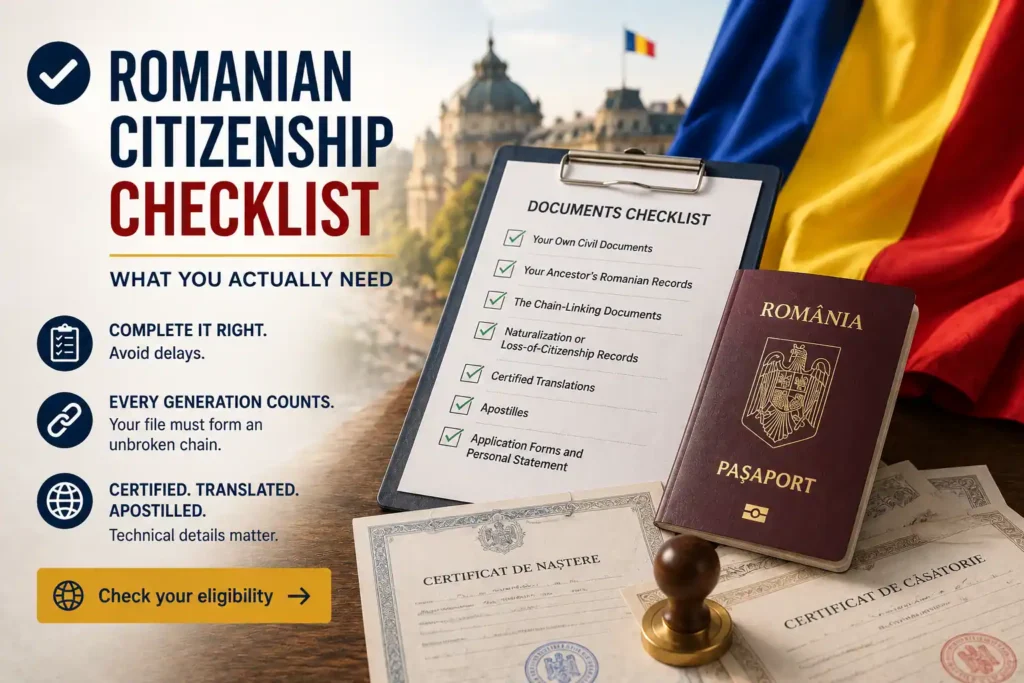
Romanian Citizenship Documents Checklist: What You Actually Need
Most delays in a Romanian citizenship case are not caused by the law itself, they are caused by documentation that is incomplete, incorrectly translated, or missing a required certification. This guide walks through what a complete file actually needs, in the order it is usually assembled.
Your Own Civil Documents
The starting point is always your own record set: your birth certificate, and, if applicable, your marriage certificate if your surname changed. These need to be recent certified copies rather than old originals sitting in a drawer, since Romanian authorities generally require documents issued within a limited period before submission.
Your Ancestor’s Romanian Records
Next comes the documentation proving your ancestor’s Romanian citizenship: typically their Romanian birth certificate, and where relevant, their Romanian identity documents or citizenship certificate from before they emigrated. This is often the hardest piece to obtain, particularly for cases going back to a grandparent or great-grandparent, since it may require requesting records directly from the Romanian civil registry office (Stare Civilă) in the locality where they were born.
The Chain-Linking Documents
Between your ancestor and you sits a chain of birth and marriage certificates for every generation in between, each one showing the parent-child relationship and accounting for any name changes along the way. A missing link here, such as a grandmother’s marriage certificate that would explain a surname change, is one of the most common reasons a file gets sent back for additional evidence. Every generation needs to be documented, not just the endpoints.
Naturalization or Loss-of-Citizenship Records
If your ancestor naturalized in another country, records showing when and how that happened are often required, since Romanian authorities need to understand when and how Romanian citizenship was lost or, in Article 11 cases, why it was lost involuntarily. This might include naturalization certificates, immigration records, or archival documentation depending on your ancestor’s specific history.
Certified Translations
Every document not already in Romanian needs a certified translation, produced by a translator authorized to work with Romanian authorities. A translation from a general translation service is usually not sufficient; it needs to meet the specific certification standards Romanian institutions require, or the file will be rejected on a technicality unrelated to the substance of your case.
Apostilles
Documents issued outside Romania generally need an apostille, the international certification confirming a public document’s authenticity, before they can be used in a Romanian legal process. This step is frequently overlooked by applicants handling their own paperwork, since it is not always obvious that a routine document like a birth certificate needs this additional certification layer before it is submitted for translation.
Application Forms and Personal Statement
Beyond the historical documents, a formal application file includes government application forms and, depending on the pathway (Article 10 or Article 11), a statement establishing your claim and the historical basis for it. This part is administrative but needs to align precisely with the documentary evidence submitted alongside it.
The Most Common Mistake
The single most frequent error is submitting documents that are individually correct but do not form an unbroken chain, for example a birth certificate that lists a different spelling of a name than the corresponding marriage certificate, with no document to explain the discrepancy. Romanian authorities read the file as a continuous chain of evidence, not as a folder of separate documents, so any inconsistency needs to be resolved before submission rather than after a rejection.
Next Step
Assembling this file correctly the first time saves months compared to filing with gaps and responding to requests for additional evidence later. We review what you already have, identify exactly what is missing, and help you obtain and certify it correctly before the application is filed.