
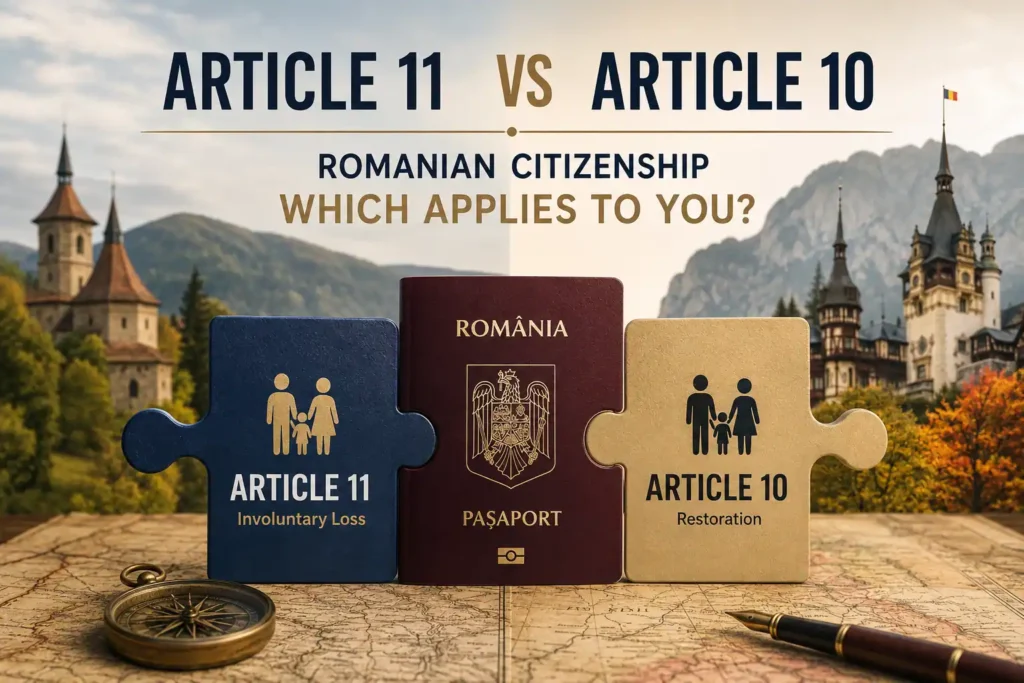
Article 11 vs Article 10 Romanian Citizenship: Which Applies to You
Anyone researching Romanian citizenship by descent eventually runs into two terms that sound similar but describe very different legal paths: Article 10 and Article 11 of Law no. 21/1991. Understanding which one applies to your case matters, because it determines the documents you need, the government body reviewing your file, and, in many cases, how long the process takes.
What Article 10 Covers
Article 10 governs restoration of Romanian citizenship for former Romanian citizens who lost it, and, importantly, extends this right to their descendants up to the second degree — typically children and grandchildren of the person who originally held Romanian citizenship. This is the pathway most people mean when they talk about “reclaiming” citizenship through a parent or grandparent who was born in Romania or who held Romanian citizenship before emigrating.
Applications under Article 10 are generally handled through Romania’s National Citizenship Authority (Autoritatea Națională pentru Cetățenie), and the process centers on proving that the ancestor genuinely held Romanian citizenship and that the applicant descends directly from them.
What Article 11 Covers
Article 11 addresses a different situation: individuals who lost Romanian citizenship involuntarily, against their will, due to circumstances beyond their control, such as annexations, forced border changes, or specific historical events recognized under Romanian law, along with their descendants. This is often relevant to families with roots in regions that were part of Romania before World War II and were later transferred to neighboring states, most commonly involving Bessarabia, Northern Bukovina, or Herța.
Because Article 11 deals with historically documented, involuntary loss of citizenship, it can, in some circumstances, apply across more generations than Article 10, since the legal reasoning is different: the citizenship was not voluntarily given up, so its restoration to descendants is treated differently under the law.
Why the Distinction Actually Matters
Choosing the wrong article, or not realizing which one your case falls under, is one of the more common reasons applications stall. The two pathways require different supporting evidence. An Article 10 case needs to demonstrate a clear, direct lineage and often naturalization records showing when and why citizenship was lost. An Article 11 case needs to establish the historical circumstances of the loss, which may involve archival and territorial history specific to the region your ancestors came from.
Applicants sometimes assume their case is straightforward Article 10 restoration, only to discover during document research that their family’s history actually falls under Article 11 because of where and when their ancestors lived. This changes both the paperwork strategy and, in some cases, realistic processing expectations.
Bessarabia, Bukovina, and Why Region Matters
If your ancestors came from what is now Moldova, parts of western Ukraine, or specific border regions, Article 11 is frequently the relevant pathway rather than Article 10, because their loss of Romanian citizenship was tied to the 1940 territorial changes rather than personal emigration decisions. This is a distinction that generic online guides often blur, but it has real consequences for how a case should be built.
How to Determine Which Article Applies to Your Case
The starting point is always the ancestor’s story: where they were born, when and why they left or lost citizenship, and what documentation exists to support that history. From there, the applicable article becomes clearer, and the required document trail can be mapped out accordingly. This is not something that should be guessed at, since building a file under the wrong article wastes both time and the cost of document retrieval.
Next Step
If you are unsure whether your family’s history falls under Article 10 or Article 11, the most efficient step is a case review before you start collecting documents. We look at your family’s specific history and region of origin and tell you which pathway applies, so the document research is targeted from the start rather than adjusted midway through.