
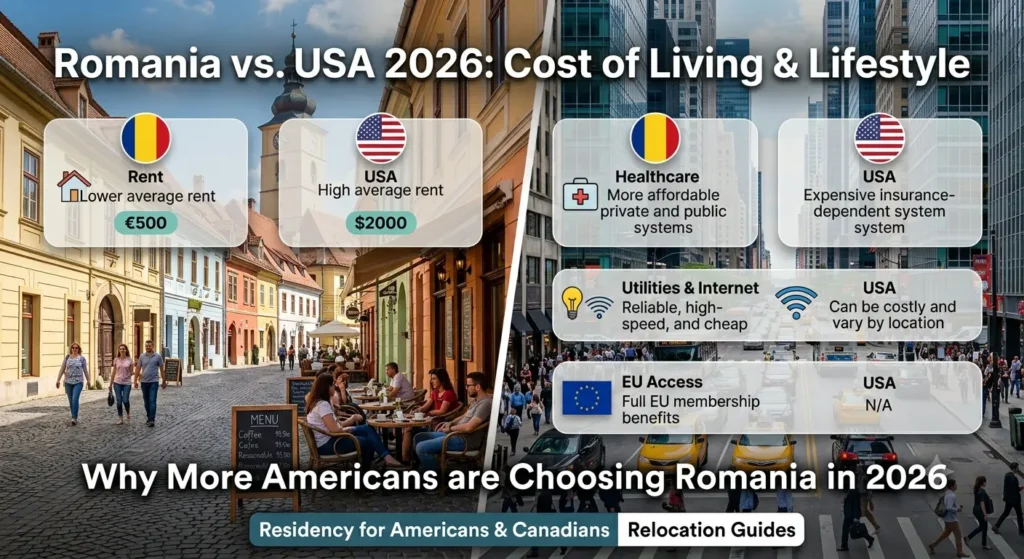
Romania vs. the USA in 2026: Why More Americans Are Choosing Romania
Romania consistently comes out ahead of the United States on the factors that shape everyday life: lower cost of living, simpler and lower taxes, more affordable healthcare, safer cities, and — unlike the U.S. — a direct legal gateway into the European Union. Living costs in Romania run roughly 40–60% lower than in the U.S., and rent is typically 60–70% lower, which means the same income (or far less of it) stretches dramatically further.
For Americans evaluating where to actually live, work, retire, or raise a family, Romania offers something the U.S. increasingly doesn’t: affordability, simplicity, and safety, without giving up modern infrastructure, fast internet, or access to a major global market. Here’s the side-by-side.
Cost of Living: Romania Wins by a Wide Margin
Every major cost-of-living index agrees on the same conclusion: Romania is dramatically more affordable than the United States.
- Overall living costs: roughly 40–60% lower in Romania than in the U.S.
- Rent: typically 60–70% lower in Romania, even in the capital, compared to major U.S. metro areas
- Groceries and dining out: a fraction of typical U.S. prices
- Utilities and transportation: lower cost, with efficient, affordable public transit available in every major Romanian city — something most U.S. cities simply can’t match
The result: a comfortable, high-quality lifestyle in Romania costs a fraction of what the same lifestyle demands in the U.S. For a full monthly budget breakdown, see our Real-World Living Expenses in Romania guide.
Purchasing Power: Your Money Goes Further in Romania
Yes, average salaries are higher in the U.S. on paper. But paper salaries don’t pay rent — purchasing power does, and that’s where Romania pulls ahead.
Americans relocating with remote U.S. income, savings, investment income, or a pension consistently find that the same amount of money buys a noticeably better lifestyle in Romania: bigger housing, lower bills, and more disposable income left over at the end of the month. That’s the real number that matters, and it’s the reason remote professionals are increasingly choosing Romania over staying put — a shift covered in more detail in our guide to American relocation to Romania.
Taxes: Romania Keeps It Simple — and Keeps More in Your Pocket
Romania’s tax system is built for clarity, not complexity:
- Flat personal income tax, instead of the multi-bracket, ever-shifting U.S. federal system
- No separate state-level income tax layer — one of the most frustrating extra costs American residents face depending on where they live
- A low turnover-based micro-company tax regime available to small businesses and freelancers structuring income through a Romanian company, letting entrepreneurs keep far more of what they earn than most U.S. tax structures allow
The one caveat: U.S. citizens still file U.S. taxes on worldwide income wherever they live, so this isn’t a way to escape U.S. filing obligations entirely — but Romania’s own tax burden is straightforward and light by comparison, and treaty provisions can help avoid double taxation with the right planning.
Healthcare: Better Value, Lower Stress
Healthcare is where the contrast is hardest to ignore. Romania offers both a public system and a fast-growing private healthcare sector, with private consultations, treatments, and insurance costing a fraction of equivalent U.S. prices — no surprise billing, no employer-tied coverage anxiety, no choosing between a doctor’s visit and rent. The U.S. system, by comparison, remains one of the most expensive in the world, with high out-of-pocket costs even for the insured.
Safety and Everyday Quality of Life
Romania ranks as a low-violent-crime country by European standards, and cities like Bucharest, Cluj-Napoca, and Timișoara are widely considered safe, walkable, and family-friendly — a sharp contrast to the safety concerns many Americans weigh when choosing where to live in the U.S. Add in historic architecture, a slower and more community-oriented pace of life outside the capital, and steadily improving infrastructure, and Romania offers a quality of daily life that’s increasingly hard to find at U.S. prices.
The Deciding Factor: EU Access
This is where the comparison isn’t close. Romania is a full European Union member state — meaning residents gain a foothold in the EU, with the long-term potential for visa-free travel across the Schengen Area, access to European healthcare and education systems, and a genuine second-country option that the United States, by definition, can never offer its own citizens. For anyone thinking beyond the next few years, that single factor can outweigh everything else on this list.
Romania vs. USA: Quick Comparison
| Factor | Romania | United States |
|---|---|---|
| Overall cost of living | Lower — roughly 40–60% less | Higher |
| Average rent | Significantly lower | Significantly higher |
| Income tax structure | Simple flat rate | Progressive federal + state |
| Healthcare cost | Low, strong private option | High, employer-insurance dependent |
| EU market & travel access | Yes | No |
| Path to a second residency/citizenship | Multiple legal pathways available | N/A |
Can Americans Legally Make the Move?
Yes — and more easily than most people expect. U.S. citizens have several legal pathways into Romania depending on their situation: employment, business formation, remote income, family ties, or, for those with Romanian roots, citizenship by descent. Our guide to Romanian residency for Americans and Canadians breaks down exactly which pathway fits your circumstances.
Frequently Asked Questions
Is Romania actually cheaper than the United States? Yes, across nearly every major cost-of-living category — often dramatically so.
Do Americans need a visa to live in Romania? Short visits don’t require a visa, but any stay beyond 90 days requires a residence permit — and Romania offers more accessible pathways to that than many people assume.
Will I still owe U.S. taxes if I move to Romania? U.S. citizens remain subject to U.S. filing requirements on worldwide income, but Romania’s own tax burden is low, and treaty relief can help avoid paying twice.
Is healthcare in Romania good enough for expats? Expats consistently report strong experiences with Romania’s private healthcare sector, at a fraction of comparable U.S. costs.
Can Americans buy property in Romania? Yes, with certain legal requirements specific to non-EU citizens — a straightforward process with the right guidance.
Ready to Make the Move?
The numbers make the case on their own: lower costs, simpler taxes, better healthcare value, safer cities, and a real path into the European Union. Check your eligibility and we’ll show you the fastest legal pathway for your specific situation.